Electromechanical conversion
How current produces torque and rotation produces back EMF and internal feedback.
Before you begin: electrical power and the rotational equation of motion.
After this lesson you can: derive an energy balance, convert motor constants and identify power-flow direction.
Work through the explanation, examples, practical experiment and independent exercises.
Two sides of one conversion
For a DC motor with constant magnetic flux, current produces electromagnetic torque and rotation produces EMF. Both relationships are needed for an energy-consistent model. kt is in N·m/A and ke in V·s/rad. Their numerical values are equal for an ideal converter in consistent SI units; here both are 0.1. Convert a constant quoted in volts per 1000 rpm before using it.
Back EMF is not a loss
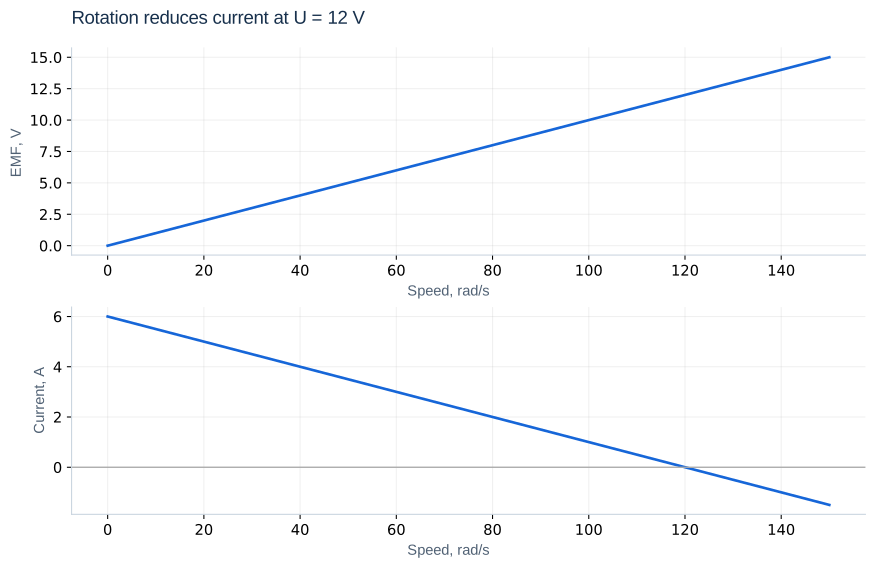
Back EMF opposes the applied voltage in motoring operation, reducing current as speed rises. Its product with current is converted power, not additional loss. At rest it is zero. This coupling creates natural negative feedback even without an electronic controller.
For steady current, i = (U − keω)/R. At U = 12 V and R = 2 Ω, currents at 0, 60 and 120 rad/s are 6, 3 and 0 A. During a transient, the inductive derivative cannot simply be omitted.
Deriving the power balance
ktiω = d(Jω²/2)/dt + bω² + MLω
ui = Ri² + bω² + MLω + d(Li²/2 + Jω²/2)/dt
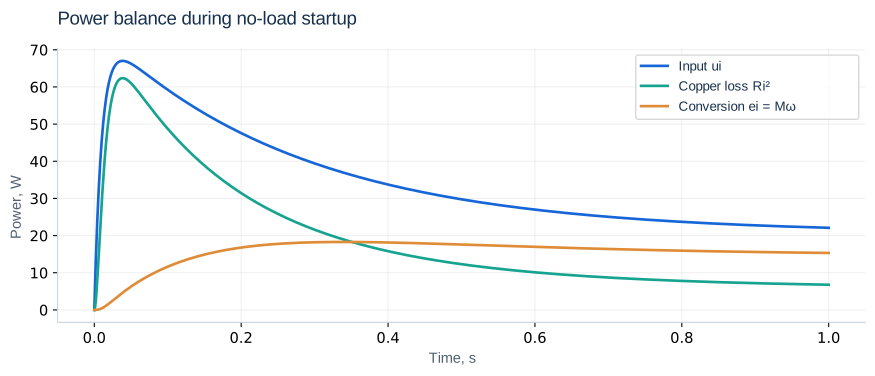
Multiply the electrical equation by i and the mechanical equation by ω. With ke = kt, internal converted power cancels. Every term is in watts. Copper and viscous losses are nonnegative; load power and input power can change sign. During acceleration, some input energy is stored. A transient efficiency assessment must account for the change in stored energy, not merely divide instantaneous load torque by current.
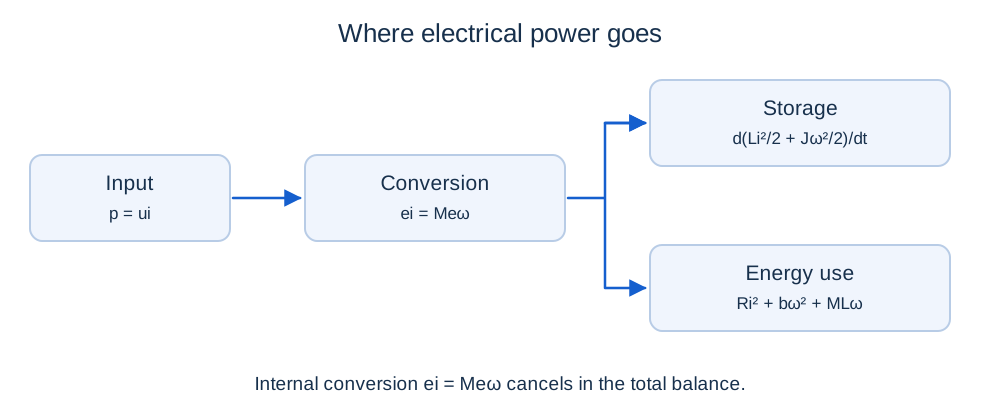
Integrate input power, losses and load power over the same interval. The balance residual should shrink as numerical accuracy improves. A small residual is useful but does not independently validate every parameter.
Natural response to load
A load increase first reduces acceleration and speed. Back EMF then falls, current rises and torque increases. The new balance has lower speed and higher current. This partly compensates the disturbance but cannot maintain exact speed. A load step directly changes speed derivative, not current itself; an instantaneous current jump suggests a static equation has replaced the dynamic one.
Nameplate constants and unit conversion
ke = 60/(2πKv) when Kv is in rpm/V
An EMF of 10 V at 1000 rpm gives ke = 10/104.72 = 0.09549 V·s/rad; the ideal matching kt is 0.09549 N·m/A. The Kv formula applies only when Kv is the reciprocal back-EMF constant in this convention. AC line/phase and RMS/peak definitions are not interchangeable with these DC quantities.
The torque–speed characteristic
The intercepts are ktU/R at zero speed and U/ke at zero electromagnetic torque. The latter is an ideal zero-torque speed, not real no-load speed with losses. Equilibrium requires Me = ML + bω.
At ω = 60 rad/s and ML = 0.1 N·m, the base motor needs i = 2.2 A and u = 10.4 V. Input power is 22.88 W, copper loss 9.68 W, viscous loss 7.2 W and load power 6 W. Their sum closes the balance. Load-power efficiency is 26.2% for these teaching parameters.
Independent exercises
1. At u = 12 V, i = −1 A and ω = 140 rad/s, identify power-flow directions. Use R = 2 Ω and ke = kt = 0.1.
Show solution
Input power is −12 W: the source receives energy. Converted mechanical power is −14 W: mechanics supplies electricity. Copper loss is 2 W. Current derivative is zero, but this alone does not establish mechanical equilibrium.
2. At i = 3 A, ω = 50 rad/s, u = 12 V and ML = 0.1 N·m, find the energy accumulation rate for the base motor.
Show solution
W′ = 36 − 18 − 5 − 5 = 8 W. Also i′ = 50 A/s and ω′ = 50 rad/s², giving magnetic storage rate 3 W and kinetic storage rate 5 W.
Practical work
At ω = 80 rad/s and i = 2 A, calculate e = 8 V, Me = 0.2 N·m and converted power 16 W on both sides. Copper loss is 8 W and required voltage 12 V for steady current. Explain when current becomes negative and why energy return also depends on the converter topology.
Calculated illustrations
Key takeaways
Current and speed are coupled in both directions. Back EMF provides an energy-consistent connection and natural feedback. Power balance detects sign and unit errors.
Progress is stored only in this browser.